Frequently asked questions

Starting a business is a big step. We know you have many questions. Our existing franchisees did too - so here are some of what they asked.

We have answered some of the most common questions about:

• the business model
• the investment required
• how the system works
• what your role looks like

These are designed to give you a clearer understanding of how the business operates.

If you have a question that you don’t see here, just get in touch and we’ll be back with an answer ASAP, or we are happy to jump on the phone and have a conversation.

Get in touch today
Thank you! Your submission has been received!
Oops! Something went wrong while submitting the form.
Franchise Model

Why should I buy a franchise instead of starting my own business?

Starting your own business from scratch can be rewarding, but it also comes with significant risk, uncertainty, and a long learning curve. Buying a franchise gives you a faster, more structured path to business ownership.

With a franchise, you are not starting from zero. Instead, you step into a business model that has already been developed, tested, and refined over many years.

Some of the key advantages for you as a franchise owner include:

You reduce risk by following a proven model
Rather than guessing what works, you follow structured systems, processes, and tools that have already been successfully used by more than 90 franchise owners operating across multiple countries since 2010.

You start with professional tools and brand positioning
Instead of spending years building systems, marketing platforms, and operational processes, you gain access to established technology, branding, and workflows that help you operate like a larger, more professional business from day one.

You gain support instead of operating alone
Running an independent startup can feel isolating. As a franchise owner, you benefit from guidance, training, and shared knowledge from experienced people who want you to succeed.

You improve your chances of securing funding
Lenders often view franchise businesses as lower risk than independent startups because they are based on established models with known performance history.

You continue learning as your business grows
Ongoing training and support help you build new skills, avoid common mistakes, and grow your confidence as a business owner.

In short, franchising allows you to focus on building your business and serving customers, rather than spending years figuring everything out on your own.

What is the history of Refresh Renovations?

Refresh Renovations was created to solve a major problem in the residential renovation industry, not simply to start another construction business.

Before Refresh was established, the founders were involved in strategic consulting within the building and construction sector. Through working with large industry companies, it became clear that the residential renovation market was enormous, but highly fragmented and often delivered inconsistent results for homeowners.

This fragmentation created an opportunity for a better way of delivering renovation projects, using structured systems, clear processes, and professional project management.

Refresh Renovations was established in 2010 in Auckland, New Zealand to bring structure and professionalism to a fragmented industry.

As the model proved successful, it expanded internationally, entering Australia in 2015, the United Kingdom in 2017, and the United States in 2019.

From the beginning, the focus was on building a scalable business model that could be used by business owners, not just builders. The model was designed to combine strong planning, clear communication, and reliable systems to improve project outcomes and customer experiences.

For you as a potential franchise owner, this history matters because it means:

You are joining a business built on real industry insight
The model was developed after years of research and practical experience in the construction sector, rather than being created as a small local trade business that later became franchised.

You benefit from a structured approach designed for growth
Refresh was built from the outset to be scalable and repeatable, giving you access to systems and processes that support long term business development.

You are part of an internationally proven model
Expansion into multiple countries demonstrates that the systems and processes can be successfully adapted to different markets and operating environments.

Today, Refresh operates across multiple countries and continues to refine its systems and processes to support franchise owners in building sustainable, professional businesses.

How many franchise businesses are currently operating within the group?

Currently, there are more than 90 Refresh Renovations franchise businesses operating across Australia, New Zealand, the United Kingdom, and the United States.

The first Refresh Renovations business was established in 2010, and the network has grown steadily since then.

For you as a potential franchise owner, this means you are joining an established and growing network of business owners who are already operating within the system.

What this means for you:

You are joining a proven network
Rather than being the first to test the model, you benefit from more than a decade of experience gained across multiple markets and operating businesses.

You gain access to shared knowledge and experience
Being part of a network of franchise owners allows you to learn from others who have already faced similar challenges and developed practical solutions.

You benefit from continued growth of the brand
As the network continues to grow across different countries, it strengthens the brand, improves systems, and supports ongoing investment into tools, training, and support that help franchise owners succeed.

Do I need building knowledge or experience to be successful? Are the most successful franchise owners those with building experience?

No. You do not need building industry experience to be a successful franchise owner.

In fact, many of the most successful franchise owners come from business, sales, management, and professional backgrounds rather than construction trades.

As a franchise owner, your primary role is to lead and grow your business, not to carry out construction work yourself.

Your role as a franchise owner focuses on business leadership
You are responsible for managing the growth of your business, building relationships with customers, and leading your team. Experienced project managers and skilled tradespeople are responsible for coordinating construction work and delivering the projects.

Successful franchise owners are business minded leaders
The most successful franchise owners are typically systems driven individuals who can lead people, manage performance, deliver a premium customer experience, and maintain a steady pipeline of work.

You build a team with the right technical expertise
Rather than relying on your own technical skills, you employ or engage experienced professionals, such as sales consultants, project managers, designers and specialist trades, who focus on selling and delivering projects..

Franchise owners come from a wide range of backgrounds
Existing franchise owners have come from industries such as business management, sales, IT, law, customer service, hospitality, and other professional sectors. What they have in common is strong leadership, communication skills, and a commitment to following proven systems.

What this means for you

You do not need to be a builder to succeed
Your success is driven by leadership, organisation, and customer management, not by hands on construction skills.

You operate as the leader of a professional team
This structure allows each person to focus on their area of expertise, improving efficiency, communication, and project outcomes.

You can build a scalable business
By leading a team rather than performing technical work yourself, you are better positioned to grow a larger, more sustainable business over time.

Who are Refresh’s competitors?

The residential renovation market is highly fragmented, and competition typically comes from a wide range of small operators rather than a few large national companies.

For you as a franchise owner, this creates an opportunity to stand out by offering a more structured and professional service than many independent operators.

Your main competitors are typically small, independent contractors
Most renovation businesses are small, trade based operations that focus on one type of work or rely heavily on individual trades. These businesses often operate without structured planning systems, formal project management processes, or integrated technology.

This creates an opportunity for you to differentiate your business by offering a more organised, transparent, and professionally managed customer experience.

Many trades prefer working with well organised businesses
Rather than seeing trades as competitors, many skilled tradespeople actively seek to work with businesses that provide clear planning, reliable workflows, and professional project management. A structured approach makes their work more predictable and efficient, which often makes your business an attractive partner for quality trades.

Some franchise systems specialise in a single type of renovation
There are franchise concepts that focus on specific areas such as bathrooms, kitchens, or other individual services. While these businesses can be effective in niche areas, they often limit the range of services offered and may restrict supplier choices.

By contrast, the Refresh model allows you to manage a wide range of renovation projects, providing flexibility and the ability to serve customers across multiple project types.

How you stand out in the market

You offer a professionally managed design and build service
Rather than focusing on individual trades, the business is structured to deliver complete renovation solutions through planning, coordination, and professional project management.

You deliver consistency and structure that many competitors lack
Using established systems and processes helps ensure projects are organised, transparent, and professionally managed, creating confidence for customers and partners alike.

You can attract and retain quality trades
Work, not leads, well managed projects, clear communication, and consistent workflows make your business appealing to skilled tradespeople who prefer working in organised environments, and focus on delivery rather than sales and marketing. They will want the ongoing work from your pipeline, and will therefore ensure they give you excellent pricing and preferential service.

What this means for you

You compete on professionalism, not price alone
Offering structured planning and project management helps position your business as a premium service provider.

You can build strong relationships with quality trades
Many trades value working with organised businesses, which is why you will build reliable delivery teams over time.

You benefit from operating in a large and fragmented market
The diversity of small competitors creates opportunities for well organised businesses to stand out and grow.


How do I manage leads and projects?

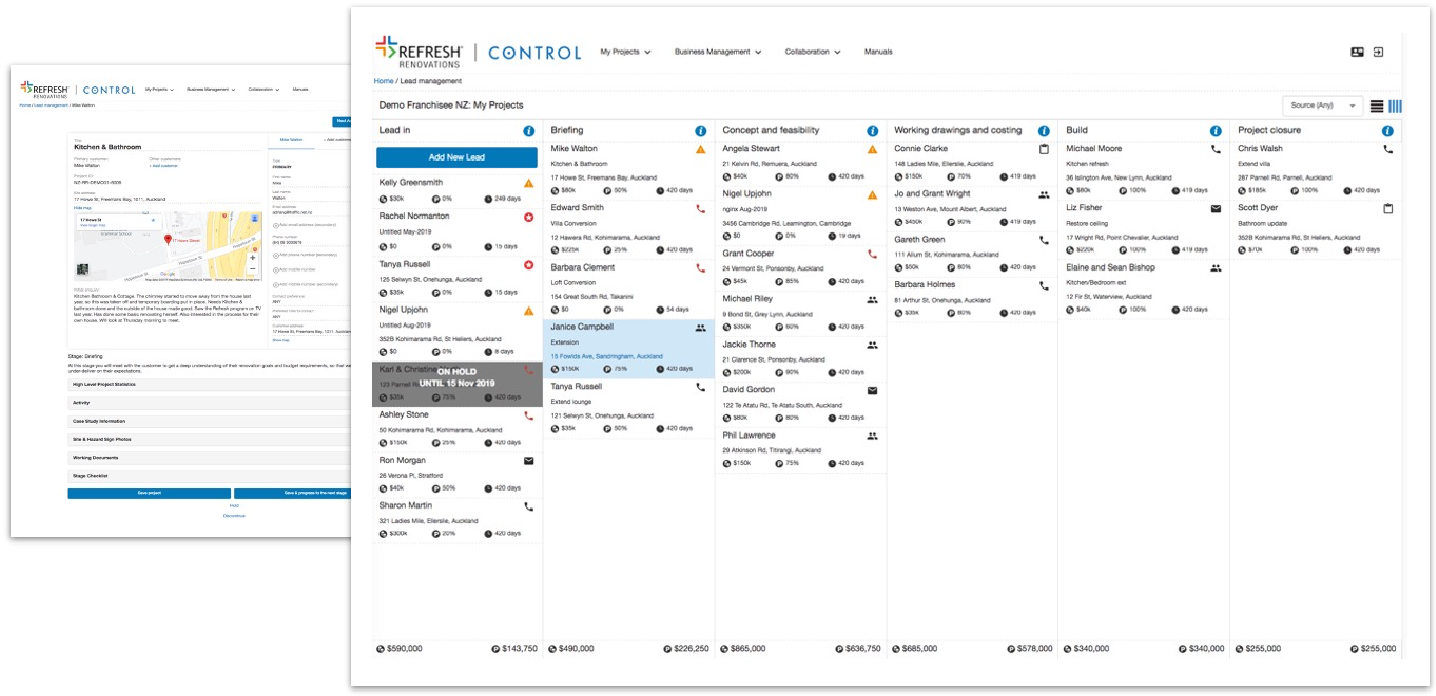
You manage your leads and projects using an integrated system designed to give you clear visibility and control across every stage of your business.

For you as a franchise owner, this means you can track opportunities, manage customer relationships, and oversee projects in a structured and organised way.

Clear visibility of your sales and project pipeline
The system provides a complete view of your leads and active projects, helping you understand what work is coming in, what is in progress, and what needs attention. This allows you to plan resources effectively and maintain steady business momentum.

Tools to support stronger sales performance
Pipeline management tools help you track enquiries, follow up opportunities, and forecast future work. This proactive approach supports better decision making and helps you work toward your revenue and profitability goals.

Structured scoping, costing, and pricing processes
Specialized tools guide you through the scoping, costing, and pricing of projects, helping ensure that work is clearly defined and properly documented. This structured approach reduces misunderstandings, protects margins, and supports consistent project outcomes.

Systems that support strong trade relationships
A well managed pipeline also helps you build confidence with trades and suppliers. When they can see that your business provides a steady and organised flow of work, you become a valuable and reliable customer to them.

What this means for you

You stay in control of your business
Clear visibility across leads and projects helps reduce surprises and supports better planning.

You reduce risk through structured processes
Consistent documentation and defined project scopes help protect margins and reduce misunderstandings.

You become more attractive to quality trades
Reliable workflows and steady project activity make your business appealing to skilled trades and suppliers.

See how the system works in practice

To help you better understand how leads, projects, and financial performance are managed, we recommend watching the short overview video below.

Watch the Control System Overview Video:
InsertControlVideoLinkHereInsert Control Video Link HereInsertControlVideoLinkHere

Market

What are the market drivers for remodeling and renovation?

Residential remodeling and renovation activity is driven by predictable life events and lifestyle changes rather than short term trends. This creates ongoing demand across many communities and economic cycles.

The business focuses on homeowners in higher value segments who are investing in improving their homes for lifestyle, comfort, and long term property value, rather than low cost repair or budget focused work.

Key drivers of remodeling and renovation demand

Changes in family life stages
Many projects are triggered by life changes such as growing families, children leaving home, aging parents moving in, or homeowners planning to age in place. These transitions often require homes to be reconfigured to better suit changing needs.

Buying or selling homes
Homeowners frequently remodel or renovate after purchasing a property to personalize it, improve functionality, or increase value. Others improve their homes before selling to improve market appeal and resale outcomes.

Lifestyle improvements and home enjoyment
Many homeowners choose to remodel or renovate to improve how their homes look, feel, and function. Projects are often driven by the desire for better kitchens, bathrooms, outdoor living spaces, or more efficient layouts that support modern living.

Focus on higher value customer segments
The business is designed to serve homeowners who value professional planning, design, and project management. These customers are typically less price driven and more focused on achieving quality outcomes and long term value.

Research driven targeting and marketing

Industry data, including national household segmentation studies, is used to identify consumer groups with a higher likelihood of undertaking remodeling and renovation projects. This data helps guide local marketing strategies and ensures franchise owners are targeting customers who are more likely to move forward with projects.

Marketing teams also analyze customer enquiries to understand common project triggers and questions. This insight is used to develop website content and digital marketing strategies that align with what homeowners are actively searching for online.

What this means for you

You operate in a market driven by real life events
Demand is influenced by predictable lifestyle changes, creating ongoing opportunities for business growth.

You focus on customers who value professional service
Targeting higher value homeowners helps support stronger project outcomes and more stable business performance.

You benefit from research based marketing support
Data driven targeting helps ensure your marketing efforts are focused on customers most likely to undertake projects.

How does an economic downturn impact the remodeling and renovation market?

Residential remodeling and renovation activity has historically shown strong resilience during economic downturns compared with new home construction and commercial building.

During the global financial crisis of 2008 to 2009, the remodeling and renovation market experienced only modest declines in many regions, while new home construction and commercial development dropped significantly. This reflects the fact that many remodeling projects are driven by necessity and lifestyle needs rather than speculative investment.

Why remodeling and renovation activity remains resilient

Many projects are needs based, not optional
Homeowners often remodel or renovate due to life events such as growing families, aging in place, property maintenance, or changing household needs. These drivers continue even during economic uncertainty.

Homeowners improve existing homes instead of moving
In tighter economic conditions, homeowners may delay purchasing new homes and instead invest in improving their current properties. This can increase demand for remodeling and renovation services.

Financing remains accessible in many cases
Lenders often remain comfortable financing remodeling projects because the finance is against an  existing asset, which provides security against the loan. New homes and commercial developments suffer as they are speculative and no asset exists until it’s built.

Market demand has remained strong through recent disruptions
Over the past decade, the remodeling and renovation sector has shown consistent growth across many markets. Even during periods of disruption such as the mortgage backed lender led “great recession” of 2007-2009 and the COVID pandemic, demand remained strong as homeowners invested more in improving their living spaces.

Regional growth supports long term opportunity
In markets such as Texas, population growth, housing demand, and aging housing stock continue to support steady remodeling and renovation activity. Industry projections indicate continued growth in remodeling spending over the coming years, driven by practical needs rather than speculative development.

What this means for you

You operate in a market that is generally more resilient than new construction
Demand is often supported by necessity driven projects rather than purely discretionary spending.

You benefit from serving multiple project types
The ability to handle a wide range of remodeling and renovation projects helps reduce reliance on any single market segment.

You are positioned to adapt to changing market conditions
Flexible service offerings and structured processes help franchise owners adjust to shifts in demand over time.

You offer a unique, professionally managed design-and-build renovation process that addresses a clear market need, giving you a distinct competitive advantage.

Do new home builds impact the remodeling and renovation market?

Yes - new home construction can actually support long term remodeling and renovation demand rather than reduce it.

New homes typically become future remodeling projects. Many homeowners begin updating kitchens, bathrooms, outdoor areas, and layouts within the first few years of ownership as their needs and preferences evolve.

How new home construction supports remodeling demand

New homes become future remodeling projects
It is common for homeowners to make improvements to kitchens, bathrooms, and living spaces within the first few years after moving into a new home. As families grow and lifestyles change, additional remodeling needs naturally follow.

Remodeling demand is driven by existing housing stock
Most remodeling and renovation activity occurs in established homes rather than newly built ones. As housing stock ages, the need for repairs, upgrades, and modernization increases, creating ongoing demand for remodeling services.

New construction does not replace remodeling demand
Growth in new home construction does not typically reduce remodeling demand. Instead, both sectors tend to grow over time as population increases and housing markets expand.

Territory planning is based on existing remodeling activity
Territory sizing is based on key indicators such as owner occupied households, estimated annual remodeling activity, and projected project demand. New home construction activity is not included in the territory calculations, ensuring that territories are based on current, measurable remodeling demand rather than future assumptions.

What this means for you

You benefit from both existing and future demand
Existing housing stock drives immediate remodeling activity, while new homes create additional future opportunities.

You operate in a market with long term growth drivers
Population growth and housing expansion support sustained remodeling demand over time.

Your territory is based on real demand, not speculation
Market sizing focuses on proven remodeling activity rather than uncertain future construction levels.

Operations

Is the business seasonal? When is the best time to start trading?

The residential remodeling and renovation market operates year round, so the business is not highly seasonal. While certain types of projects are more common at different times of the year, homeowners continue planning and completing remodeling projects in every season.

Seasonal patterns in project types

There can be some seasonal variation in the types of enquiries you receive, rather than in the overall level of demand.

For example:

  • Spring and summer often see increased demand for outdoor projects such as decks, patios, and landscaping related work
  • Fall and winter commonly bring enquiries related to indoor improvements such as kitchens, bathrooms, heating upgrades, and insulation
  • Year round, homeowners plan extensions, remodeling projects, and full home renovations

Because your business covers a wide range of project types, this variety helps maintain a steady pipeline of opportunities throughout the year.

Why the business remains active year round

Many remodeling and renovation decisions are driven by life events rather than seasons.

Common triggers include:

  • Growing families
  • Aging homeowners adapting their homes
  • Property purchases or sales
  • Lifestyle changes such as working from home
  • Repair or modernization needs

These needs arise throughout the year, helping support consistent demand.

When is the best time to start trading?

There is no single best time to start. Franchise owners successfully begin operations throughout the year.

In fact, starting earlier allows you to:

  • Begin building your brand presence in your territory
  • Establish your trade and supplier relationships
  • Develop your initial pipeline of work
  • Gain experience with the systems and processes

The sooner you begin building momentum, the sooner your business can grow.

What this means for you

You are not dependent on one season
Demand exists throughout the year across different project types.

Your pipeline evolves with seasonal trends
Different project types balance activity across the year.

You can start at any time of year
There is no need to wait for a specific season to launch.

Your growth depends more on activity than timing
Consistent marketing and engagement drive results, not the calendar.

Financial

Besides the franchise fee, what other costs are involved in buying the franchise and getting established? How much working capital is required?

In addition to the franchise fee, there are several startup and early operating costs to consider. These costs are fully outlined during the due diligence process to ensure you have a clear understanding of your investment requirements.

One of the advantages of this business model is that it is designed to be asset light, meaning you do not need large capital investments such as commercial premises, heavy equipment, or inventory.

Typical startup and establishment costs

Most franchise owners are able to start their business from home with relatively simple equipment. Typical early requirements include:

  • A reliable vehicle
  • A phone and computer
  • Business setup and licensing costs
  • Initial marketing and business development activities
  • Insurance and professional services
  • Training and onboarding costs
  • Early operating expenses

A full breakdown of these costs is provided in Item 7 of the Franchise Disclosure Document (FDD). This section includes a table outlining the expected cost categories from signing the agreement through the first three months of operation, along with estimated low and high investment ranges.

Working capital requirements

Working capital is the cash available to support your business during the early growth phase. This may include funds or access to financing, such as a line of credit or overdraft facility, to cover operating expenses while your revenue pipeline is building.

The amount of working capital required varies depending on your business plan, growth expectations, and local market conditions.

Financial planning support

As part of the due diligence process, you will be provided with a Profit and Loss (P&L) planning template. This tool allows you to estimate the costs of running your business based on your individual assumptions, including:

  • Revenue targets
  • Marketing investment
  • Staffing plans
  • Operating expenses

This process helps you estimate your required working capital and build a realistic financial plan before launching your business.

What this means for you

You receive full visibility of expected costs
Detailed investment information is provided in the FDD to help you understand all startup and early operating expenses.

You can start with a relatively low asset base
The home based, asset light model reduces the need for large upfront capital investments.

You can plan your finances with confidence
Financial planning tools help you estimate working capital needs based on your own goals and assumptions.

Are all costs paid at once or in stages?

Most costs associated with starting your business are paid in stages rather than all at once. This staged approach helps manage cash flow and allows you to plan your investment over time.

Full details of expected costs and payment timing are outlined in Item 7 of the Franchise Disclosure Document (FDD), but the general structure is as follows.

Initial franchise fee
The franchise fee is paid when you sign the Franchise Agreement. This secures your rights to operate the business and begin the onboarding and training process.

Professional fees cover the cost of engaging advisors such as attorneys and accountants to support the setup of your Refresh Renovations business. It is strongly recommended to seek professional advice when reviewing the franchise opportunity, legal documents, and any leases or contracts.

Working capital
Working capital is typically planned during the due diligence phase as part of your overall financial strategy. It should include sufficient funds to cover both business needs (as indicated in Item 7 in the FDD) and your personal living expenses while you are fully committed to launching the business.

In many cases, this is not provided as a lump sum but rather structured as access to funding, such as a line of credit or overdraft facility. These funds can then be drawn upon as needed to support the business through its early growth stage.

Ongoing royalty and marketing fees
Royalty fees and national brand marketing contributions are ongoing monthly costs based on your business performance.

One important advantage of this model is that royalties are based on revenue received, not simply invoiced work. This helps support early cash flow, particularly during the startup phase.

During the first 12 months of operation, there is no minimum monthly royalty requirement. After the first year, minimum royalty thresholds apply in accordance with the Franchise Agreement, as outlined in the FDD.

Other startup and operating costs
Additional costs such as marketing, insurance, staffing, and operating expenses occur progressively as your business is established and begins operating.

What this means for you

You can plan your investment in stages
Most costs occur at different points in the startup and early operating period, helping you manage your financial commitments.

You benefit from cash flow friendly royalty timing
Royalty payments based on received revenue support better financial management, especially in the early stages of your business.

You can structure working capital to suit your needs
Access to a line of funding rather than upfront spending can provide flexibility during the business ramp up phase, as money is invested over time, rather than all up front, as is the case with many franchise systems.

Training

How long does the initial training last? Where does it take place? How much does it cost?

Initial training is delivered through a structured program that combines in person training, field experience, and ongoing onboarding support to ensure you are fully prepared to operate your business.

Training is designed to build your confidence and capability before and during the early stages of your operations.

Initial induction training

The initial induction is typically conducted at our global head office in Auckland, New Zealand and lasts for approximately 4-5 days. During this time, your training includes:

  • Classroom based instruction covering systems, processes, and business operations
  • Hands on training in core workflows and tools
  • Site visits with experienced franchise owners to observe live projects
  • Exposure to real world project delivery environments

This experience provides both theoretical knowledge and practical insight into how the business operates.

Post induction onboarding support

After completing the initial induction, you return to your local market and begin implementing what you have learned. A structured onboarding program continues as your business becomes operational.

During this phase:

  • You begin working with real leads and projects
  • Ongoing coaching and support are provided
  • Your capability is developed across each stage of the project lifecycle
  • Progress is reviewed to ensure you are confident with each step of the process

Your business is progressively assessed and supported until you demonstrate capability across all key areas.

Additional regional or online training

Additional training sessions are typically conducted on-line by US or regional head office staff. These sessions typically total approximately 28 hours and reinforce operational and technical knowledge.

Training costs

There is no separate fee charged for the initial induction training.

Estimated travel and accommodation costs for one person attending the Auckland training are approximately $7,500, and this cost is covered on your behalf.

If additional attendees join the training, or if travel expenses exceed the standard estimate, those additional costs would be your responsibility.

What this means for you

You receive comprehensive training before launching your business
Training includes both classroom learning and real world exposure.

You continue receiving advice and guidance after initial training
Learning continues as your business becomes operational.

Your initial training investment is supported financially
Core training costs are included, with travel support provided for one attendee.

Do you provide ongoing training such as courses, workshops, conferences, seminars, regional meetings, refresher, or advanced training? Are these covered in my monthly fees?

Yes, ongoing training and support are a core part of the franchise system. Learning does not stop after initial training — continuous development is provided through a range of programs designed to help you grow and improve your business over time.

Most ongoing training and support activities are covered by your regular monthly fees, as outlined in Item 7 of the Franchise Disclosure Document (FDD).

Structured onboarding and ongoing support

Following your initial training, you continue through a structured onboarding program that supports you as your business grows. Ongoing guidance is provided to help you strengthen your skills across all aspects of the business.

Training and support may include:

  • Regular coaching and business reviews
  • System and process training
  • Refresher and advanced training sessions
  • Workshops and seminars
  • Regional and group meetings
  • Access to updated training materials and resources

Training on systems and processes is ongoing, and refresher training is typically provided as needed without additional charge.

Annual conferences and special events

From time to time, an annual conference may be held. These events provide opportunities to:

  • Learn from experienced franchise owners
  • Share ideas and best practices
  • Receive updates on systems and strategy
  • Build relationships across the franchise network

If an annual conference is held, attendance may be required. You would typically be responsible for travel and accommodation costs, and an attendance fee of up to $1,000 may apply, as outlined in the Franchise Agreement. Conference duration is limited to no more than five days in any calendar year.

In many cases, conference costs may be partially offset through contributions from the Monthly Fee and supplier sponsorships.

What this means for you

You receive ongoing advice and guidance beyond initial training
Training continues throughout your journey to support business growth and performance.

Most training is included in your monthly fees
Advice and guidance meetings, webinars etc. are covered as part of your ongoing support structure.

You stay current with best practices and new developments
Workshops, seminars, and conferences help keep your knowledge and skills up to date.

Do you provide training for any staff I employ? Is this covered in my monthly fees?

Yes, training is available for both you and your team. Supporting your staff development is an important part of building a successful and scalable business.

Most core training for your team can be accomplished through their sign-up and participation with regularly scheduled on-line training sessions or in person if requested associated cost highlighted in Item 6 of the FDD.

Training is available for key team roles

Training programs are regularly delivered to support the development of staff across different areas of the business. These may include:

  • Lead management and sales training
  • Project delivery and operational training
  • Administrative and business management training
  • Systems and process training

These sessions help ensure that everyone in your business understands their responsibilities and works effectively as part of the overall system.

You participate alongside your team

In many cases, you will attend training sessions alongside your employees. This helps reinforce consistency across your team and ensures everyone understands how their roles fit within the overall business structure.

Most training is included in your monthly support

The majority of ongoing staff training is delivered through:

  • Online training modules within the Learning Management System
  • Live virtual training sessions
  • Support from the Operations team
  • Access to updated training materials and resources

In most cases, this training is available at no additional cost and is covered through your regular monthly fees.

Additional in person training when required

If specialized or additional in person training is requested for your staff, additional charges may apply. These typically include trainer fees and any associated travel or accommodation expenses, as outlined in Item 11 of the Franchise Disclosure Document (FDD).

What this means for you

Your team can be trained without building programs from scratch
Structured training helps your staff quickly understand their roles and responsibilities.

Most staff training is already included
Online and virtual training resources allow you to develop your team without significant additional costs.

You can request additional training if needed
Optional in person training is available when more intensive training is required.

Marketing

What kinds of marketing programs do you run for specific franchise regions?

Marketing is delivered through a structured mix of national brand building and local territory marketing. You receive tools, training, and support to help you implement proven marketing programs that generate enquiries and build long term visibility in your local market.

Your marketing activity typically includes four key areas.

Digital and online marketing
Digital marketing plays a major role in generating enquiries from homeowners searching for remodeling or renovation services. You are provided with resources, systems, and guidance to help plan and implement cost effective digital campaigns. These may include search marketing, online advertising, website visibility, and local search optimization.

Customer relationship marketing
Past customers and enquiries are a valuable source of repeat work and referrals. You are provided with systems, databases, and training to help you stay in contact with previous customers and generate ongoing opportunities from your existing network.

Trade and professional relationship marketing
Building strong relationships with trades, suppliers, and professional partners is an important source of referrals. You are supported with strategies and tools to help develop these networks and generate opportunities through industry relationships.

Local marketing communications
You receive marketing collateral, branding tools, and communication resources to support your local campaigns. This may include brochures, presentation materials, signage, and personalized phone tracking systems to help measure marketing effectiveness.

Local advertising and community sponsorships
These activities create brand awareness and preference in your local community. There are many examples of the kinds of initiatives successful franchisees have undertaken that you can use to assist with your decision making as to what you want to do in this category.

Marketing tools, training, and ongoing support
You are provided with a structured marketing toolkit, training programs, and performance benchmarking to help guide your local marketing decisions. These resources are designed to help you implement consistent marketing activities that build awareness and generate a steady pipeline of leads.

What this means for you

You are not expected to create marketing from scratch
You receive proven tools, templates, and guidance to support your local marketing efforts.

Your marketing is multi channel and structured
Using a mix of digital, referral, and relationship based marketing helps create a steady flow of opportunities.

You can measure and improve performance over time
Tracking tools and benchmarking help you understand which marketing activities are delivering the best results.

Do you have a marketing launch strategy (go to market) for a new franchise territory? If so, what does this look like?

Yes, a structured go to market strategy is provided to help you establish your presence and begin generating leads as quickly as possible.

This strategy is delivered through a combination of a 12 week onboarding program and a Local Marketing Support Plan (LMSP), both designed to guide your early marketing and business development activities.

12 week onboarding and launch preparation

Your onboarding period includes structured steps to prepare your business for launch. During this time, you will set up your systems, finalize your local marketing plan, and begin building awareness in your territory.

Typical activities during this phase include:

  • Setting up your local marketing channels
  • Preparing your website and digital presence
  • Identifying local networking and relationship opportunities
  • Planning early marketing campaigns
  • Establishing supplier and trade relationships
  • Building your initial project pipeline

This preparation ensures your business is ready to engage customers from the moment you begin operating.

Local Marketing Support Plan (LMSP)

The Local Marketing Support Plan outlines recommended marketing activities and timing of implementation, designed to build awareness and generate enquiries within your territory.

This includes guidance on:

  • Local networking and relationship building
  • Community engagement and industry visibility
  • Digital and online marketing campaigns
  • Ongoing lead generation activities
  • Tracking and measuring marketing effectiveness

Some approved activities may be supported through co-funded marketing initiatives.

Marketing momentum begins early

Rather than relying on a single launch event, your marketing approach is designed to create consistent visibility and a steady flow of enquiries. This structured rollout helps you build momentum and develop your pipeline over time.

What this means for you

You start with a clear marketing roadmap
Your early marketing activities are planned and structured rather than improvised.

You receive step by step support during launch
The onboarding and LMSP processes guide your actions during the critical startup phase.

You build momentum from the beginning
Marketing activity begins early to help establish visibility and generate opportunities in your territory.

Support

Exactly what level of advice and guidance can I expect? Is there technical support and ongoing research and development, especially for the Refresh Control system?

You can expect comprehensive advice and guidance across all aspects of your business, including operational guidance, technical assistance, and ongoing development of the systems you use every day.

This begins during your initial training and continues throughout your ownership journey.

Structured training and onboarding support

You will receive full training on the use of the Refresh® Control system during your initial induction training in Auckland, New Zealand. This training continues through your structured onboarding process once you return to your local territory and begin operating your business.

During this stage, you will be supported step-by-step as you apply the system to real projects and build confidence in using the platform.

Access to operating manuals and training resources

Comprehensive operating manuals and system documentation are available to help you refresh your knowledge or learn new features as your business grows. These materials provide ongoing reference support whenever needed.

Ticketing system and technical support

If you require assistance, support is available through a dedicated ticketing system. This includes:

  • An AI powered chatbot designed to answer common questions quickly
  • A system for submitting issues 
  • Access to experienced system specialists when additional help is required

This layered structure ensures help is available when you need it.

Ongoing research and development

Refresh® Control is continuously enhanced to improve usability, efficiency, and functionality. Development is supported by a dedicated IT subsidiary based in Delhi, India, focused exclusively on building and improving the platform.

The development team works closely with leadership to prioritize improvements and ensure the system continues to evolve alongside the needs of franchise owners.

A purpose built business platform

Refresh® Control was developed as a cloud based business management platform because existing systems did not support the structured design and build model used in residential remodeling and renovation businesses.

The platform supports key areas of your business, including:

  • Lead and pipeline management
  • Project planning and delivery
  • Team coordination
  • Financial tracking and reporting
  • Customer communication

What this means for you

You are supported from day one
Training and onboarding ensure you build confidence using the system before and during operations.

Help is available when you need it
Multiple support channels provide quick access to technical and operational assistance.

Your system continues to improve over time
Ongoing development ensures your technology remains current and competitive.

You operate with tools designed specifically for this business model
The platform supports structured workflows that help reduce risk and improve efficiency.